NHB Polyhouse Subsidy
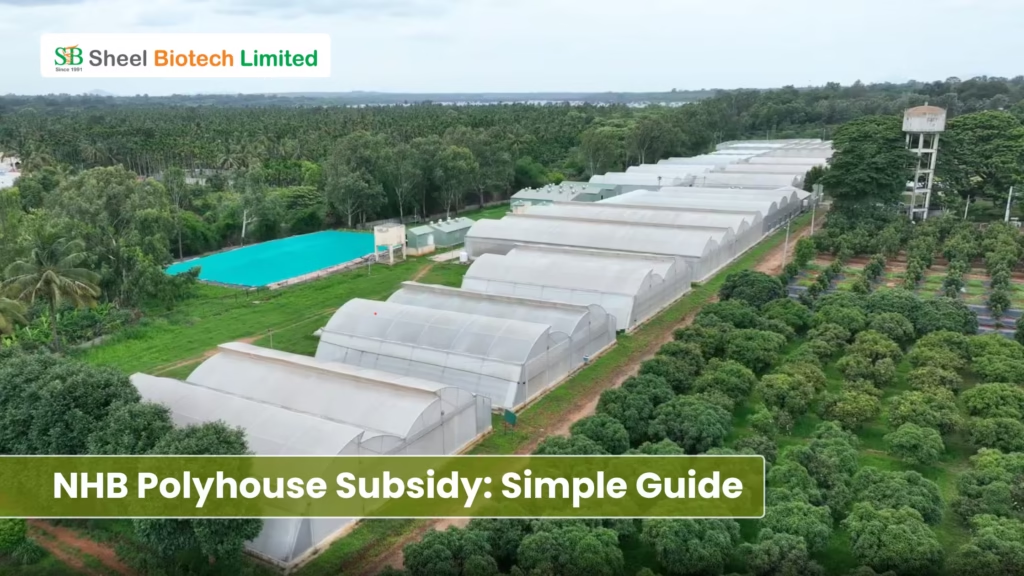
If you are thinking of starting a polyhouse, greenhouse, or shade net farming project and want to take subsidies from the National Horticulture Board (NHB), this guide will help you understand everything in a simple way.
Instead of using difficult terms, we will explain step by step:
- What structure to build
- What crops to grow
- How much subsidy you can get
- How the process works
By the end, you will clearly understand how this scheme works.
Important Note
Subsidy rules and amounts can change anytime based on government updates.
So before making any investment, always confirm the latest details.
Why Government Gives Subsidy for Polyhouse Farming
Polyhouse farming is supported by the government because it helps farmers earn more and reduce risk.
Inside a polyhouse or shade net house, you can:
- Protect crops from rain, heat, wind, and bad weather
- Reduce pests and diseases
- Use less water and fertilisers
- Grow high-value crops like flowers and exotic vegetables
This helps increase farmer income and produce better quality crops.
How Subsidy Works (Simple Explanation)
The subsidy is not given in advance.
- First, you take a bank loan and build your project
- Then NHB checks your project
- After approval, subsidy is directly added to your loan account
This reduces your total loan amount.
1. Minimum and Maximum Area
To apply for NHB subsidy:
General Areas:
- Minimum: 4,000 sq. m.
- Maximum: 16,000 sq. m.
North East Region:
- Minimum: 1,000 sq. m.
2. What Things Are Covered
You can get subsidy on:
- Building polyhouse / greenhouse / shade net
- Plastic mulching
- Growing crops inside the structure
3. Which Crops You Can Grow
Flowers:
- Rose
- Gerbera
- Carnation
- Orchids
- Lilium
- Chrysanthemum
Vegetables:
- Capsicum
- Cucumber
- Tomato
4. How Much Subsidy You Get
- You can get 50% of the project cost
- Maximum subsidy: ₹1 crore per project
5. Structure Cost (Important)
Subsidy is based on these fixed costs:
- Fan & Pad Greenhouse: ₹1,600 per sq. m.
- Polyhouse (Natural Ventilation): ₹1,000 per sq. m.
- Shade Net House: ₹710 per sq. m.
6. Crop Cost Support
You also get support for crops:
- Vegetables: ₹150 per sq. m.
- Orchids & Anthurium: ₹700 per sq. m.
- Gerbera & Carnation: ₹610 per sq. m.
- Rose & Lilium: ₹450 per sq. m.
7. Extra Things Covered
You can also include:
- Irrigation system (up to ₹4 lakh)
- Land development (₹60,000 per acre)
- Packhouse / grading room (₹4 lakh)
- Small machines and tools
8. Important Rules
You must follow these:
- Use good quality material approved by NHB
- Follow proper design and cost standards
Who Can Apply
- Individual farmers
- Companies or firms
- Societies and trusts
Step-by-Step Process (Very Simple)
Step 1: Make Your Project Plan (DPR)
This includes:
- Area and location
- Structure type
- Crop plan
- Total cost
Step 2: Collect Documents
- Aadhaar, PAN
- Land documents or lease (12 years minimum)
- Location details
- Photos
For companies:
- Registration papers
- Board resolution
Step 3: Apply for Bank Loan
Go to a bank and apply for an agriculture loan.
If approved, you will get a sanction letter.
Step 4: Apply to NHB
- Submit documents with bank approval
- Pay NHB fees
- Wait for approval (6–8 weeks)
After approval, you get GOC (Grant of Consent)
Step 5: Start Construction
- Give GOC to bank
- Bank pays vendor
- Construction starts (around 45–60 days)
Step 6: Start Farming
- Plant crops inside the structure
- Update details on government portal
Step 7: Inspection
NHB and bank will check:
- Structure quality
- Area
- Crops
- Investment
Step 8: Get Subsidy
- NHB approves subsidy
- Money is directly added to your loan account
Step 9: Repay Loan
Now your loan is reduced, so repayment becomes easier.
Timeline (Easy View)
- DPR & documents: 1–3 weeks
- Bank approval: depends on bank
- NHB approval: 6–8 weeks
- Construction: 45–60 days
- Subsidy release: 5–6 months
Types of Structures
- Fan & Pad Greenhouse – High control, expensive
- Polyhouse – Balanced option
- Shade Net – Low cost, simple
If you are serious about modern farming, this subsidy can help you start a strong and profitable project.
But the key is:
- Proper planning
- Right crop selection
- Correct execution
Next Step
If you are confused about where to start, take expert help.
In a consultation, you can:
- Check if your land is suitable
- Decide the best structure
- Choose the right crop
- Understand cost and subsidy clearly
- Get a step-by-step plan
National Horticulture Board (NHB) Scheme
This is the main scheme for commercial-scale projects.
- Target Group: Individual farmers, FPOs, startups, and agri-entrepreneurs.
- Area Requirement: Minimum 2,500 sq. m (general) or 1,000 sq. m (North East/Hilly areas).
- Subsidy Rate: Flat 50% of the admissible project cost.
- Financial Ceiling: Up to ₹56 Lakhs per project (can go up to ₹1 Crore for specific high-tech structures).
- Application: Apply online via the NHB Schemes portal before starting construction.
Mission for Integrated Development of Horticulture (MIDH)
Best for small and medium-scale farmers.
- Target Group: Individual small/marginal farmers and groups.
- Area Range: typically covers 500 sq. m to 4,000 sq. m.
- Subsidy Rate: Base of 50%.
- State Variations: Many states provide “top-ups.” For example:
- Uttarakhand: Total subsidy up to 80% for 500 sq. m units.
- Rajasthan: Up to 70%–95% for SC/ST and small/marginal farmers.
- Application: Managed by the District Horticulture Officer (DHO). Applications are often submitted via state portals like RajKisan (Rajasthan) or iKhedut (Gujarat).
Pradhan Mantri Krishi Sinchayee Yojana (PMKSY)
While focusing on irrigation, this scheme supports greenhouse farmers through the Per Drop More Crop (PDMC) component.
- Coverage: Financial aid for installing drip irrigation and fertigation systems inside the greenhouse.
- Subsidy Rate: 55% for small/marginal farmers and 45% for others.
- Integration: Usually combined with NHB or MIDH applications to cover the entire setup.
- Eligibility Checklist for 2025–26
- Land Ownership: Clear title (Jamabandi) or a 15+ year registered lease.
- Mandatory Documents: Aadhaar, PAN, soil/water test reports, and a Detailed Project Report (DPR).
- Bank Loan: Term loan must cover at least 25%–40% of the total project cost.
- Critical Rule: You must obtain a Letter of Intent (LOI) from the department before buying materials or starting construction, or you will be disqualified.
Connect With Us
Let Sheel Biotech be your partner in success.