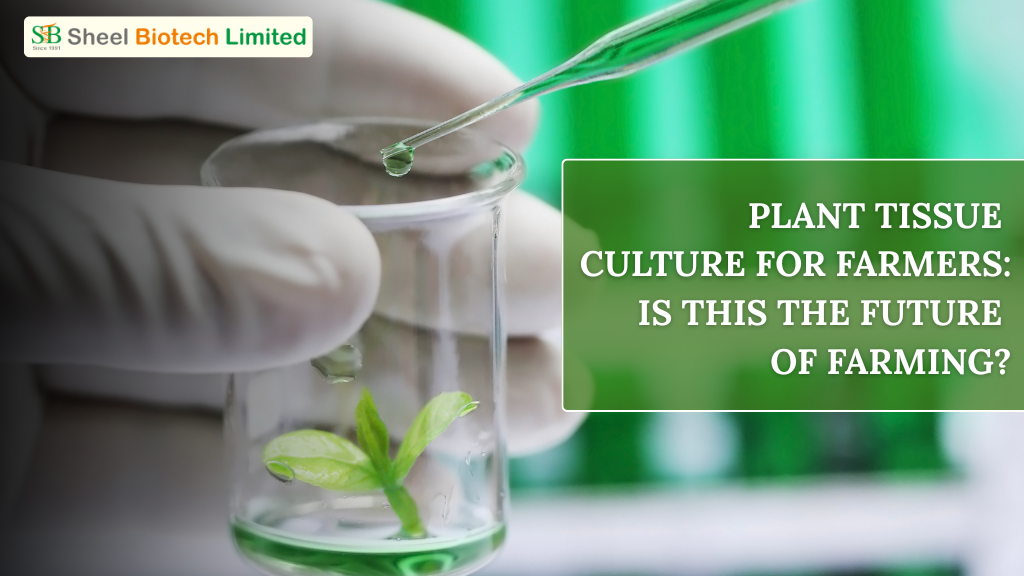
Have you ever looked at a thriving field and wondered what farming might look like in the next ten years? Many farmers across India and abroad ask the same question. As demand for disease free planting material grows, and climate patterns shift every year, every grower looks for technology that can provide stability. This is exactly where plant tissue culture steps into the conversation.
Today, more commercial farmers and agribusiness owners want methods that reduce risks and give predictable returns. You may have already heard researchers speak about plant tissue culture, but have you ever asked yourself how it actually helps your farm? Or how this technology can fit into your production cycle without disturbing the practices you already trust? Let us explore it together.
Why Are Farmers Everywhere Talking About Plant Tissue Culture?
Let us begin with a simple question. What matters the most to you when you plant a new crop? You want uniformity, fast growth, strong roots, and a plant that does not fall victim to disease. This is the exact value that plant tissue culture brings to the table. It allows experts to create thousands of identical plants from a single tiny piece of tissue. Imagine growing a complete field where every plant behaves the same way. That level of consistency is something traditional propagation methods rarely offer.
For commercial farmers, this means predictable yields and greater control over the quality of produce. For horticulturists, this means perfect ornamental plants that look the same in every pot. For government bodies and research institutions, it creates large scale supply options for projects that require clean and uniform planting material.
Is Plant Tissue Culture Really Practical for Large Farms?
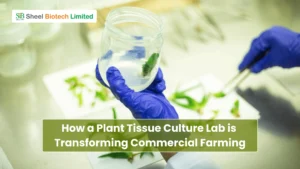
This is a fair question and one that many farmers raise. The answer is yes, when supported by the right infrastructure and technical guidance. The process starts in a sterile laboratory where trained professionals work with science backed techniques. Once the plantlets are ready, they enter a hardening phase and then move to controlled environments. These steps ensure that the plants adapt well to real world farm conditions.
Large scale farms benefit because the technology reduces the chances of disease carrying mother plants entering the field. When every plantlet begins its journey in clean and controlled conditions, your field receives a consistent and strong foundation. You save time, you save resources, and you reduce unnecessary losses.
How Does It Benefit Agribusinesses and Contract Farming Operations?
If you run an agribusiness, you already understand how crucial supply chain predictability is. A single disease outbreak in the mother stock can disturb an entire season of production. With tissue culture raised plants, this uncertainty drops significantly. Businesses that rely on exports also prefer this technology because global buyers value uniform quality and disease free material.
Contract farming groups can expand their operations confidently because they no longer depend on scattered nurseries for variable quality planting material. Instead, they can source identical batches that align with business needs and production schedules.
Why Are Research Institutions Supporting This Technology So Strongly?
Research institutions often lead the movement towards better farming practices. They look at long term sustainability instead of quick results. When they recommend tissue culture, they are not doing it for trend value. They recommend it because they see how this method supports global efforts towards better food security, sustainable growing, and climate ready varieties.
Some institutions also use tissue culture to preserve rare species, multiply high value medicinal plants, and support large government projects that aim to uplift farming communities.
Common Concerns Farmers Have
Every new technology brings questions. Here are a few concerns farmers often ask.
Will the plants survive after moving from controlled conditions to open fields?
Yes, when properly hardened, the plants adjust well. The key is to work with reliable suppliers who follow correct hardening procedures.
Does tissue culture eliminate the need for traditional farming knowledge?
Not at all. It supports your existing skills. It acts as a foundation, not a replacement.
Is it expensive?
It is an investment, but it often pays for itself through improved uniformity, disease resistance, and higher commercial value.
If you have asked any of these questions, you are not alone. Thousands of farmers have the same curiosity, and the ones who adopt early often see the strongest long term benefits.
Is This the Future of Farming? Let Us Look Ahead
If you think about the future of agriculture, one thing is clear. The world wants cleaner, safer, and more reliable crops. Buyers want residue free produce. Government organisations want stable supply for food security. Farmers want to reduce risk. All of these needs connect directly to technologies that improve nursery standards.
That is why tissue culture is not a passing idea. It is a long term solution that fits perfectly with modern farming demands.
Conclusion
At this stage, you might be wondering who can support you with dependable tissue culture solutions. This is where we at Sheel Biotech Limited stand apart. We are recognised as the best company in the field of Bio technology, Floriculture, Green Houses, Organic Adoption and Certification and Turnkey Projects because we combine scientific accuracy with deep respect for the farming community.
We work closely with commercial farmers, agribusinesses, government bodies, horticulturists, and research institutions to supply top quality planting material and future ready agricultural solutions. Our teams focus on strong scientific processes, reliable delivery, and complete support at every stage, from laboratory to field.
If you plan to introduce advanced propagation techniques into your farming or institutional project, we at Sheel Biotech Limited are ready to guide you with solutions that combine precision, reliability, and trust.